| Introduction | ||||||
|
In
November of 1984 I was visiting New York and looked up Al H. Morrison
(1916-1995), editor of the CAO TIMES. Walter Mondale had just
lost the US election to Ronald Reagan, and Michael Lutin had
taken me along to a 'losers party' consisting largely of a clan
reputable NY astrologers. Morrison took me on a tour to show off some of
the sites of the city and this would have been on November 8th, because
I recall the lunar eclipse of the day. From the top of the World
Trade Centre Morrison filled me in with all the history and facts of
the building. He said: "This building is fire-proof,
earthquake-proof and plane-proof." And then he turned round to me
and said: "But I reckon someone will try and fly a Boeing through
it some day." Morrison had studied the founding charts. Some 16
years later his prophecy came true. I never saw an
office apartment so crammed and disordered with literature. Robert
Hand once said to me: "The trouble with Al H. Morrison is that
he has forgotten more astrology than any other of us ever knew all put
together." One of the items that Al H. Morrison did produce
on November 8th, 1984 was an old catalogue of eclipse paths. He
directed my attention to a particular eclipse, or probably two, some 60
years BC and their relationship to Bethlehem. With reference to the
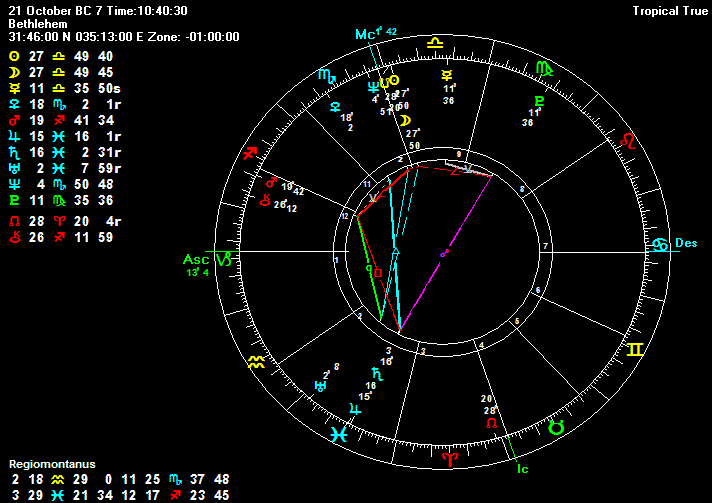
triple conjunction of Jupiter and Saturn in 6 BC, he said to me:
"Andrew, we don't quite know how the ancient astrologers or holy
priests actually worked things out.
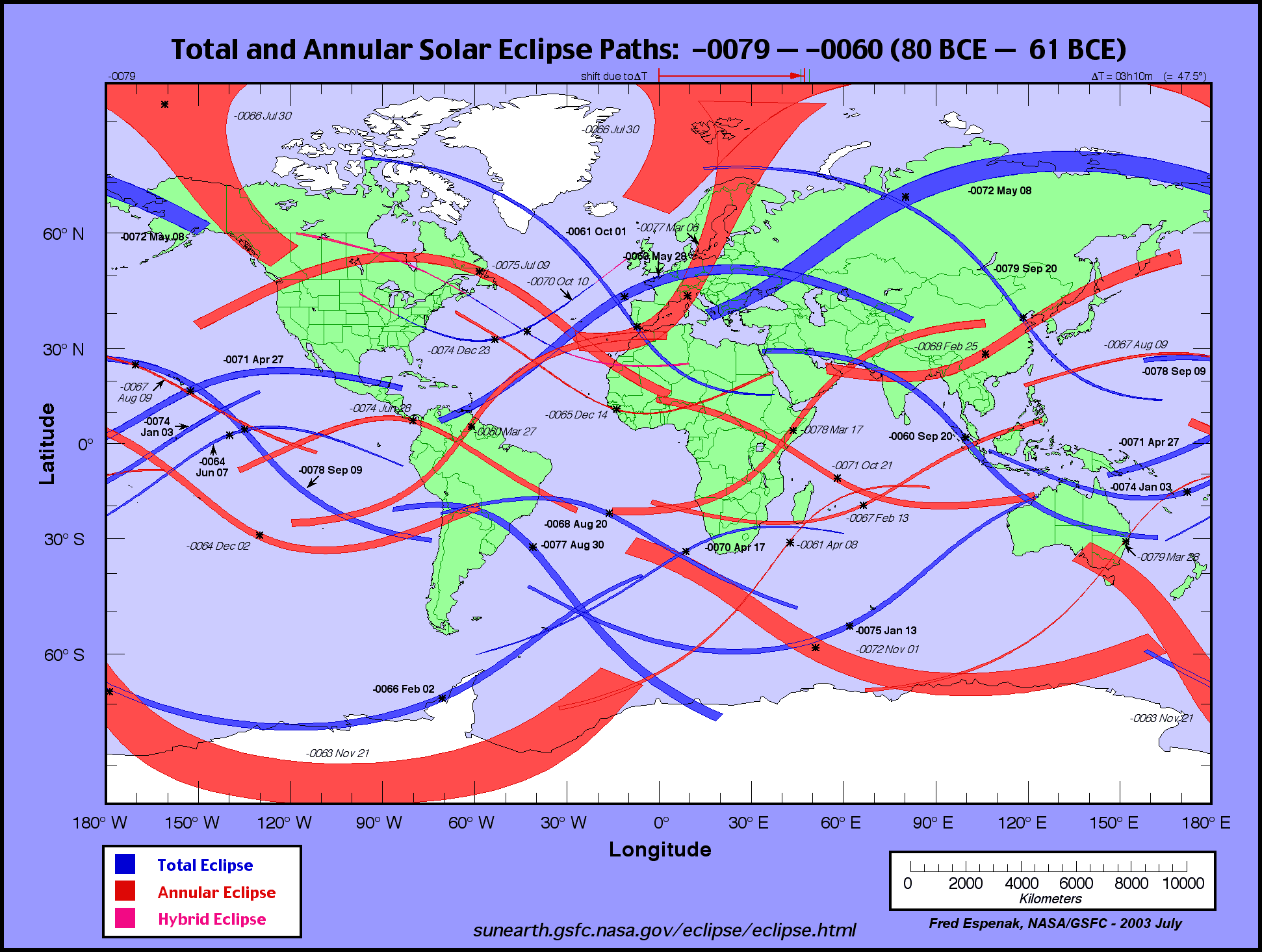
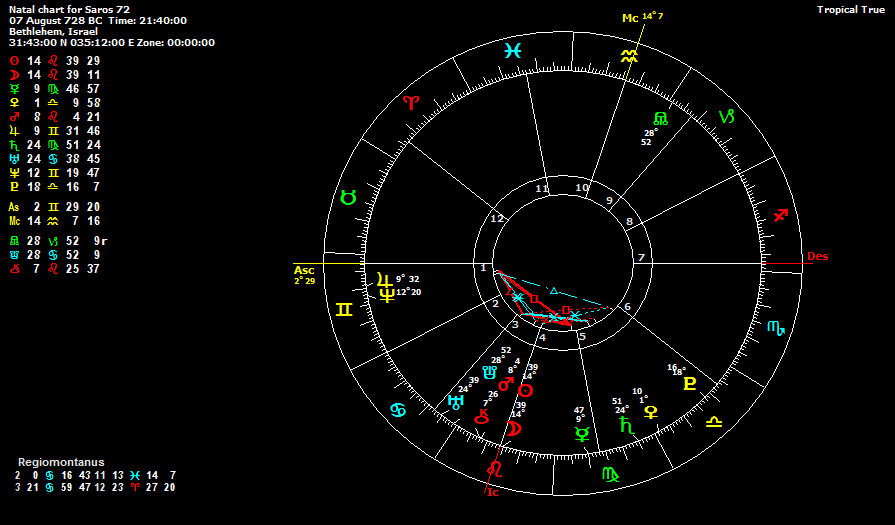
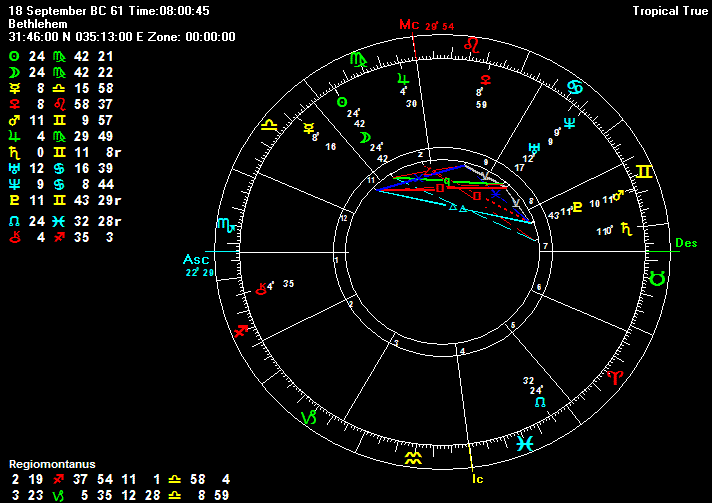
The Total Solar Eclipse of 18. September 61BC (Espenak: -0060 Sep 20) is a member of the Saros Series 72. The Saros Cycle is a progressive repetition of eclipses discovered by the Chaldeans that made it possible to predict eclipses either centuries in advance or retrospect with great accuracy. In astrology, the first and initial eclipse of a Saros series bears a founding meaning or promise that is carried on throughout the eclipse series. The Saros series 72 was born with the Partial Solar Eclipse of 7. August 728 BC. At this time the Sun and Moon paths intersect with the maximum orb and relatedness to the Moons nodes, in this case the Moon's South and descending node, which permits an eclipse of the Sun to occur. Saros series' always commence as a sequence of partial eclipses at either of the Earths polar regions, but as the series develops the conjunction of the Sun and Moon occur closer to the Moon's node, which is the point where the Sun and the Moon's path intersect. The eclipses become 'tighter'. The partial eclipses develop into total and annular eclipses, and the point of eclipse maximum moves closer to the equator. After the eclipse series has culminated and performed its eclipse of highest altitude the conjunction of the Sun and the Moon will move away from the Moons nodes, the eclipse paths will draw away from the equator and the series will eventually end in a sequence of partial eclipses in the polar regions opposite pole to where the eclipse series originally started. To understand the meaning of any eclipse it is considered important to go back and study the eclipse that originated that Saros series. The 'Mother' eclipse bears an important meaning that is carried on to future eclipses of the same series, so that the full meaning of a current eclipse is acheived by going back and studying the initiation eclipse of that same series. The Saros series 72 commenced with the annual eclipse of 7. August 728 BC. If the Saros Series 72 is related to the coming of Biblical coming of the Christ, its is interesting that this was first predicted by the prophet Isaiah who lived at the same time, 700-800 BC.
Partial Eclipse of 7. Aug 728 BC (Gregorian), Initiating Saros Series 72
The
Saros Series 72 commences with a partial eclipse that does
not strike the Earth with a path of total shadow in the same manner as a
total eclipse. The partial eclipse was not visable from Jerusalem, but
the lumanaries would have been rising in the ascendant in the East at
the time they were joined. Any planet is reckoned to be in the Heart of
the Sun, or Cazimi, for the period that it takes for that body to pass
16' before and after the Solar Center, since the approximate apparent
diameter of the Sun is 32' of orb. It is custom to observe this
longitude of orb along the ecliptic, whether the planet passes either
South or North of the solar body As a matter of technical detail, I include that the first total eclipse of Saros cycle 72 occurs on 6. April 331 BC, Gregorian calendar. However, that what was indicated at the moment of the initiating eclipse of 7. August 728 BC reached its height as the Saros cycle and was at its highest altitude as the cycle reached its maximum with the 61BC chart. The chart below shows how the Solar Eclipse of 18. September 61 BC occurs within minutes of the Moons south node. Thus, it becomes obvious that at this point the Saros series 72 is at its highest altitude. The promise of the initial eclipse of the Saros series 72 occurring on 7. August 728 BC, culminates with the eclipse of 18. September 61 BC. The Holy Priests of antiquity traced the path of the eclipse to the place where its phase of totality first struck the Earth. This was the location where they predicted that the promise of the initial eclipse would land and come to Earth. |